For a story to work, you need the combination of three things – a great plot, compelling characters and an interesting world. That last one is even more important in videogame narratives, as the worlds players explore can make or break the entire experience.
I’ve played in some amazing gaming worlds over the years, but it got me wondering … what are the best of the best? The worlds I fell in love with and was desperate to explore? The narrative settings which enhanced the plots I played through? After careful consideration, I’ve narrowed it down to twenty worlds I adored.
There are three rules you need to know before we proceed – I’m only looking at one game per franchise, I’m counting linear as well as open worlds, and this is all my personal opinion.
Before we begin, you can check out some of my related blog posts below:
Top 20 Best Videogame Narratives
My Top 20 Favourite Videogame Soundtracks
Top 20 Videogame Performances Of All Time
Every “Elden Ring” Area Ranked
20 – City 17 (Half Life 2)
In my opinion, a videogame world doesn’t have to be an open world in order for it to convey an enormous sense of worldbuilding and scale. A large, open landscape certainly helps (and you’ll notice that the top half of the list is saturated with these types of worlds) but a linear experience can be just as engrossing.
Considering “Half Life 2” came out in 2004, it’s staggering how immersive its world is – especially those first few hours in the game. City 17 immediately feels oppressive, and you get a real sense of its dystopian history.
All of the places you visit are designed well, especially the terrifying Ravenholm, but it was City 17 that gave me a reason to fight.
19 – Talos I (Prey)
“Prey” came as a huge surprise when I played it for the first time earlier this year. Not only was its gameplay engaging, but I found Talos I to be one of the best, most in-depth Sci-Fi locations I’ve ever experienced.
I love the decor of the place, for a start, but the layout of the space station felt very real and lived-in. I never doubted for a second that a colony of humans could live here for the rest of their lives.
I also really liked the level design – how different areas connected to one another, and the various secret paths you could take to reach your objective. I’m going to use the word “immersive” a lot in this ranking, I think …
18 – STEM (The Evil Within)
For my money, I think that “The Evil Within” has the greatest purely linear world we’ve seen in gaming. The rest of the entries in this list are a lot more open, sometimes in a “zonal” style, but this horror game is comprised of a series of one-off levels.
Each area you battle through is horrifying, both in the world design and the enemies you have to face, and the whole experience is survival horror at its best. This tortured, fractured world of STEM is never predictable and always thrilling.
17 – The Oldest House (Control)
“Control” is a great example of those “zonal” worlds I was talking about. While it does feel very open-ended and explorable, there are some regions which you simply can’t enter until later in the game, and you backtrack through previous areas many times – not to mention that the main elevator acts as a loading screen between all the floors.
The game takes place in The Oldest House, which is the headquarters of the FBC. Its interior is impossible and otherworldly, which is what makes it so enthralling to explore.
Whether you’re fighting enemies in a dark and infected office, singing along to a shifting corridor or running for your life in a cosmic quarry, there’s never a dull moment.
16 – Gotham City (Arkham Knight)
The Arkham games have always had the mission statement of making you feel like Batman. “Asylum” set the dark tone, “City” moved it to an open world, “Origins” was when things got visceral … but it wasn’t until “Arkham Knight” that we finally saved Gotham City – Batman’s stomping grounds.
It was a sensible idea to move all of the civilians out of the city, as that meant that all of Batman’s greatest foes could take to the streets … and that the Batmobile could cause some serious havoc.
If gliding through Gotham City was already awesome, then cruising along in the Batmobile was a dream come true.
15 – New York City (Marvel’s Spider-Man)
Yes. It’s just New York City – or a part of it, anyway. But it’s one of the best renders of New York City ever put in a game.
The whole city feels alive, buzzing with activity (both good and nefarious …), and zipping through the skyscrapers as Spider-Man had never felt smoother. I swung around this Big Apple playground for hours and it never got stale.
14 – Los Santos (Grand Theft Auto 5)
At the time of writing, GTA 6 hasn’t yet come out. It’ll have one helluva hard time topping Los Santos from “Grand Theft Auto 5” – this was the perfect sandbox for violence and chaos.
It’s an open world with everything you could ever want – rob a bank in the city or fly a jet plane over the desert and hills, whatever strikes your fancy. Whether it was the singleplayer campaign or online multiplayer, I had an absolute blast when blasting everyone and everything.
13 – Island Sequence 24 (Paradise Killer)
I was already sold on “Paradise Killer” with the premise of a grisly murder on a near-abandoned island … but I wasn’t expecting Island Sequence 24 to be so aesthetically pleasing.
The designers leant into the bright, “Vaporwave” style, and the contrast of the bloody sacrifices to the upbeat and colourful landscape was an ingenious choice. If there was ever a videogame world I’d want to live in (minus the murdering and sacrificial rituals, of course) it would be this one.
12 – Tsushima (Ghost of Tsushima)
I think we have a tendency in the Western World to say “Japan = good” for almost anything. We seem enraptured by their culture, their history, their anime, their technological innovations … but what I’m always so impressed by is the beauty of their land.
The island of Tsushima from “Ghost of Tsushima” is a breath-taking world full of all the Japanese iconography you could ever wish for. All three regions – the dense forests, the marshy plains and the snowy hills – are so graphically beautiful that I regularly paused to absorb it all.
11 – Hyrule (The Legend of Zelda: Breath of the Wild)
“The Legend of Zelda: Breath of the Wild” was a watershed moment in open world game design. Rarely before had a game given players such freedom straight from the outset.
Once you’ve completed the tutorial, you’re dropped into Hyrule and are free to explore to your heart’s content. See something in the distance worth investigating? Go for it! Want to take on the final boss straight away? I don’t recommend it, but be my guest!
Many games since have tried to replicate this level of player freedom, some of them to equally impressive degrees, but major credit should be given to Nintendo for opening those glorious floodgates.
10 – Ancient Greece (Assassin’s Creed Odyssey)
“Assassin’s Creed Odyssey” has always been one of my big guilty pleasure games. Many Assassin’s Creed fans didn’t like its story, its characters, its combat, its mission design … but one thing everyone could agree on is that this version of Ancient Greece was a joy to explore.
Despite there being large stretches of sea between the various islands, it never felt like a chore to go from A to B. The historical landmarks, cities and the sky-high synchronization points always took my breath away.
9 – Hawaii (Like A Dragon: Infinite Wealth)
“Like A Dragon: Infinite Wealth” is one of the most recent games on this list, and one of the most recent I’ve played in comparison to the others. Which is to say that its world made an immediate impression on me.
The suburban Yokohama of the previous game was certainly fun to explore, but I was glad when Ichiban and the others got to see the tropical paradise that is Hawaii in all its splendor. There are an absurd number of side activities to do across the map, and the beachy, summery vibe is immaculate.
8 – America (Red Dead Redemption 2)
I wasn’t sure which region to focus on for “Red Dead Redemption 2”, as all of the towns and landmarks come together to create an entire experience. In the end, I think “America” seems an appropriate name for this enormous landscape.
Every dude got to live out their cowboy fantasy back in 2018 – it’s so much fun to hop on the back of your trusty horse and gallop miles across the American outback. Rockstar threw in plenty of side content and random encounters to make every trek a story in itself.
7 – The Continent (Clair Obscur: Expedition 33)
The most recent game on this list, “Clair Obscur: Expedition 33” blew myself and every other gamer away with its story and combat. But one aspect which I think flew under the radar is its fantastical, unpredictable, incredibly varied world.
Every region you visit is teeming with artistry and creativity, and there’s an almost storybook feel to some of the magical glades and forests you explore. As the game progresses and you get upgrades to movement, you can then zip across the whole Continent and discover the dozens of optional areas.
This is one of the most beautiful worlds I’ve ever explored, but I can’t rank it much higher than seventh. There’s simply not that much side content inside each area – but the main narrative is more than enough to keep you invested.
6 – Faerun (Baldur’s Gate 3)
On paper, the world of Faerun doesn’t seem that big. Each of the game’s three Acts have distinct and fairly large areas, but it’s the density of those areas which make “Baldur’s Gate 3” such an all-encompassing, immersive experience.
It feels like there’s something to do every five metres, and the sheer depth of the lore and worldbuilding is staggering. I thought it would’ve taken Larian a decade to add all this stuff, but apparently it only took six years! That quick development cycle is nuts by today’s gaming industry standards.
5 – The Nine Realms (God Of War: Ragnarök)
“God Of War: Ragnarok” laughs in the face of those paltry games that only have one measly world. The developers gave us nine whole realms – each one varied and vibrant – to get lost in.
Some realms are obviously better than others (and a couple are very story-heavy and don’t have much exploration) but the highs are incredibly high. Each realm is visually and often mechanically distinct, and some of the optional content blew me away with their size and complexity.
4 – Skyrim (The Elder Scrolls V: Skyrim)
Ah, “Skyrim”. My first gaming love – and a likely culprit as to why I adore Fantasy as a genre. I remember those mornings before school and evenings after I’d done my homework where all I wanted to do was boot up this game and get lost in its sprawling world.
I spent many dozens of hours trekking across the lush green forests and glistening white mountaintops, the iconic ambience blaring in the background, and it never got stale. There are dungeons a-plenty and enough regions and cities to satiate my love of worldbuilding.
But what set “Skyrim” apart from other games I played all those years ago was its abundance of side quests. There was always something to do, a goal to push towards, and the sandbox-y nature of the game meant there was usually a handful of ways to go about it. It was a level of freedom in a videogame world I had never seen before, and it remains a joy to replay.
3 – The World (The Witcher 3: Wild Hunt)
“The Witcher 3: Wild Hunt” is one of my favourite games of all time, and yet even I had no idea its world was simply called “The World”. I guess you learn something new every day.
CD Projekt Red are the best worldbuilders in the business. Whether it was Kaer Morhen, Novigrad, Skellige, Velen, White Orchard or Toussaint, and whether you were potion crafting, monster hunting or politiking, there was always something badass to do and always an obscenely gorgeous backdrop to it all. It’s no surprise that people still point to this title when discussing the best side content in gaming. I didn’t even mention the iconic in-universe card game!
I fully believe that this is a real world. The developers must’ve peered into a parallel realm, because that’s the only way this level of detail would make sense.
2 – The Lands Between (Elden Ring)
The Lands Between from “Elden Ring” has always been one of my favourite gaming worlds ever since I played it a few years ago, but it was only when replaying it earlier this year that its utter perfection became apparent to me.
It’s not the biggest world in terms of size, but like “Baldur’s Gate 3” this is a world that shines through its history and depth. FromSoft are famed for their intricate lore and “Elden Ring” has it in spades.
What always shocks me whenever I replay this game is how varied its regions are, all whilst staying inside the Dark Fantasy genre. There are hidden dangers at every turn, regardless of whether you’re in a lava-filled manor, an underground aqueduct or a gigantic capital city. As long as you’re aiming for the prominent, glowing Erdtree, you’re probably going in the right direction.
The Lands Between feels like the perfect storm of videogame worlds. It has the overwhelming freedom of “Breath of the Wild”, the sprawling Fantasy of “The Witcher 3” and the jaw-dropping depth of “Baldur’s Gate 3”. If there’s ever an “Elden Ring 2”, it would have some shoes to fill and then some!
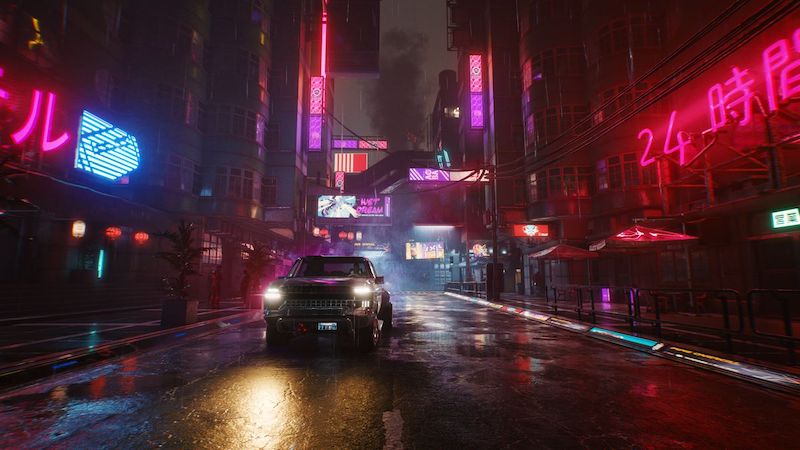
1 – Night City (Cyberpunk: 2077)
There are certain checkmarks a developer might use to make their world feel lived-in – citizens going about their daily routines, perhaps, or some lore books left around the place to convey a sense of history. Night City has these factors and then some. Even as I’m writing this, I have no idea how CD Projekt Red managed to make “Cyberpunk: 2077” feel so alive.
It’s such a terrifyingly real depiction of a potential future – so much so that it now feels set in stone, as if this will be the future we all live in. Night City is populated with awe-inspiring, multicultural architecture and bio-augmented civilians, and it all comes together to create a cyberpunk nightmare of overstimulation. It’s the dictionary definition of “immersive”.
Cities in games always have an “uncanny valley” feel to them, where the more real they feel the less real they become, but Night City was the first city in a game to break that curse. It’s a watershed moment in worldbuilding and game design, and I hope every game moving forwards takes some serious notes. It won’t be long until videogame worlds start to feel more real than our own.
Aaaand that’s my list! If you liked this post and want to support me, please consider giving me a one-time donation. Even a few pence (or whatever currency you use) is fantastic! I’ve never monetized this blog before, but it would be great if I could do this comfortably and not have to worry about the yearly website domain costs. Thank you so much!
Make a one-time donation
Make a monthly donation
Make a yearly donation
Choose an amount
Or enter a custom amount
Your contribution is appreciated.
Your contribution is appreciated.
Your contribution is appreciated.

