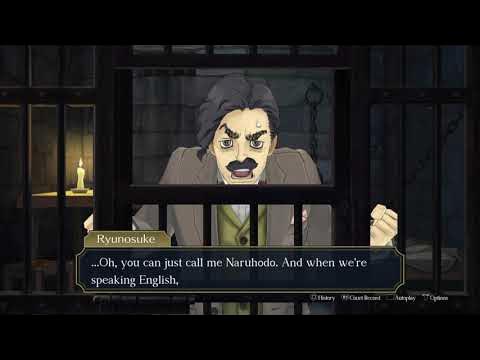
After the blood-pumping Trial in “The Adventure of the Runaway Room”, Ryunosuke and Susato take on their first real case in “The Adventure of the Clouded Kokoro”. Will it live up to the thrills of the previous case?
I’ll be deconstructing the case in ten distinct categories and giving a score out of ten for each. This will give a definitive score out of a hundred, if the maths checks out!
Before we begin, you can check out some of my related blog posts below:
Great Ace Attorney Deep Dive: “The Adventure of the Great Departure” (Case 1-1)
Great Ace Attorney Deep Dive: “The Adventure of the Runaway Room” (Case 1-3)
Every Ace Attorney Culprit Ranked
Danganronpa – Every Chapter Ranked
Micro Story
Ryunosuke and Susato were very much thrown in the deep end during the previous case, so “The Adventure of the Clouded Kokoro” is their first proper taste of an Ace Attorney story. Sadly, it’s not a particularly interesting tale.
A woman is found with a knife in her back on a foggy London street, and a Japanese immigrant named Soseki Natsume is the prime suspect. He’s a neighbour who was in the area at the time, and because 19th Century London was quite racist the police were more than happy to throw a Japanese man under the bus.
As Micro Stories go, this is pretty thin. There’s no real investment nor emotional stakes other than “the defendant is a fellow countryman!”, and the murder itself is far too mundane by Ace Attorney standards.
Score: 5/10
Macro Story
If you go into “The Adventure of the Clouded Kokoro” looking for character development in Ryunosuke and Susato, you’ll be disappointed. This case is all about them learning the ropes of Investigations and English Trials … again. The other main characters, however, make far more of an impression.
The Investigations take us to 221B Baker Street for the first time, so it’s an excellent chance to catch up with Sholmes as well as his young roommate Iris Wilson. We saw a bit of her at the end of the last case but she really starts to shine here. Both she and Holmes bring such a childish sense of wonder and whimsy to this duology – every time you go to 221B it ends up being a riot.
We’re also introduced to one of the major characters moving forwards, Scotland Yard Inspector Tobias Gregson. He’s our Gumshoe stand-in for this duology, and while he was a little frosty at first he soon becomes a classic, surprisingly intelligent, chip-eating British coppah. He’s a bloke you just want to share a bevvy with.
Those are the main Macro Story elements. I was going to talk about the overarching narrative or themes of the duology, but I don’t think they particularly come up in this case. Maybe just racism in general? Does that count?
Score: 7/10
Mystery
To give this case credit, I had absolutely no idea who the Culprit was for the vast majority of it. Soseki is the only real suspect for most of the runtime, and no other suspects, motives or means of murder are presented. If the writers were trying to write an unsolvable Mystery, they certainly did it.
It’s not obvious who did it … but I didn’t really care. You learn pretty early on that the “victim” actually survived, so why should I try to solve a Mystery when there’s hardly an inciting incident to begin with? The lack of a proper hook really lets this case down.
As a side note, was Soseki ever given a proper motive? I know it’s the racism of British police that results in Soseki getting arrested, but I can’t remember what van Zieks’ argument was for Soseki’s motive beyond discrimination. The whole Trial is spent debating whether Soseki was there, but not about why he stabbed a random stranger in the first place. A lot of the specifics of this Mystery are swept under the rug.
It was nice playing a case where the Culprit wasn’t immediately guessable … but I would’ve preferred it if it was still within the realms of possibility. By the time the final “Culprit twist” was unveiled, I’d all but given up on a satisfying Mystery.
Score: 6/10
Side Characters
By my count, there are seven Side Characters to talk about – and that’s after condensing the jury into one slot. Yikes, that’s a lot of scene-filler.
We might as well quickly talk about the jury, because they’re not as interesting this time around. The highlights are probably Bruce Fairplay (the stern witness who returns from the previous case), the forgetful old man, and the fact that the eventual Culprit was somehow assigned jury duty on this specific case. More on that in my upcoming Case Logic section …
Unfortunately – and I know this is a hot take – my least favourite Side Character in the case was the defendant Soseki Natsume. He’s whiney, over-excited and overbearing. It’s exhausting to try to keep up with him, and he’s one of the least friendly defendants in the series – which is saying something. I get that he’s terrified and a fish-out-of-water, but he lacks the common decency I expect of a human being. And the fact he hates Sholmes, my favourite character, doesn’t help either. Soseki is based on a real historical figure … If I was one of his ancestors and I played this game, I’d be pissed by his erratic characterization.
Next up is John Garrideb, the ex-army male half of the infamous Garrideb couple. He’s far more bearable than his wife but his part in the painfully unfunny double-act can’t be ignored. I mean, why did the writers think domestic abuse would be a funny character quirk? The best part about him is probably his crescent-shaped head. You don’t see many of those.
As weird as it is to say, my favourite characters in this case are probably Roly and Patricia Beate. Roly is a dozy policeman whose tiredness is endearing (at first …), and Patricia is the rosy-cheeked, starry-eyed partner of his who loves him to the moon and back. They make quite a heart-warming pair … but they’re both extremely one-note and quickly overstay their welcome.
It’s also cool how Shamspeare and Metermann, two characters who’ll appear in the second game, make cameos here. Their appearances makes sense in terms of both case’s timelines, so it’s a neat detail and some solid planning ahead by the developers.
Score: 4/10
Soundtrack
Even if the case itself is letting me down, I can always rely on the Soundtrack to lift my spirits. “The Adventure of the Clouded Kokoro” has some great songs yet again.
I really liked the new character themes for Gregson, Iris and Soseki, and some of the scene-setters like “London Town”, “Ordinary Londoners” and 221B Baker Street’s theme worked a treat.
This case also marks the first time we hear “Victory! – In Honour of My Friend” after the Trial’s success, which is a fantastic victory theme. It’s weird that it didn’t premier at the end of Case 3 … but I get it. That case ended on a bummer, both in terms of the verdict and the omnibus fire, so it would’ve been out of place to have a cheery song playing in the background.
Score: 8/10
Investigations
“The Adventure of the Clouded Kokoro” is the first case that has both an Investigation and a Trial … and it only took us four cases to get there! It’s more fun doing an Investigation which you know leads to a Trial as it means that any evidence you find could be crucial. Momentum is important in storytelling. Oh, and I completely forgot that this case only has one Investigation. I wonder why the first game in this duology is so short?
This Investigation is our first real taste of the new London setting, and I think it makes a solid first impression. Those snowy London streets feel very quaint, and places like 221B Baker Street are brimming with quirkiness.
A lot of this Investigation takes place in the Garrideb home … and it’s a little boring, especially when compared to 221B. The “lion rampage” dance of deduction is entertaining but ultimately a bit silly.
This feels like our first true taste of an Investigation, because “The Adventure of the Unbreakable Speckled Band” was a bit of an odd one. It does the job.
Score: 6/10
Trial
It’s weird how this case only has one Trial compared to the series standard of two. In hindsight, I’m extremely grateful “The Adventure of the Clouded Kokoro” of all cases didn’t stretch out any longer than it needed to.
I’m not going to sugar-coat it – this is one of the worst Trials in the series, especially considering how it’s a non-tutorial case. The whole Trial feels like one filler argument after another, and it culminates in one of the most underwhelming twists this series has ever come up with.
Other than the requisite Summation Examinations to drag out the case’s runtime, the main testimony in this Trial has to do with the patrolling policeman who supposedly “witnessed” the crime. The Beates are charming at first, but their lovey-dovey-ness eventually got on my nerves. And the predictable twist that Roly was asleep meant that his whole testimony was worthless and a borderline waste of time!
And don’t get me started on the Culprit twist. Having the attempted “murder” actually be an accident was a risky gambit, and it sometimes pays off like in “Turnabout Reclaimed”, but here it’s so contrived and it made my eyes roll. It’s such a stretch to say that a thrown knife fell out of a window and hit a woman squarely on the back. It undermines everything we’d been through in the preceding Trial.
To summarize – this Trial was charming at points, but on the whole it was a waste of everyone’s time. Thank god for van Zieks at the prosecutor’s bench, otherwise this would’ve been a total snooze-fest.
Score: 5/10
Case Logic
Oh boy, I’ve got a bone to pick in this Case Logic section.
For starters, it’s ridiculous that Joan – the Culprit – ended up on this case’s jury. I can look past people like Bruce Fairplay making a return because that’s obviously a functional decision (so the developers use less character models / cartridge space) … but the fact the Culprit was on the jury is such a ridiculous narrative contrivance. All the millions of Londoners and it just so happened to be her?
And the crime. Oh god, the crime. You’re telling me that Joan threw a knife out the window by accident, it bounced and fell downwards – point first – onto the street below, AND a passerby was bending over perfectly beneath that exact window at that exact time? Give me a break. It’s one of the worst plot contrivances this series has ever conjured.
I was going to end this segment by talking about the absurd “lion rampage” dance of deduction that Holmes postulates … but it’s actually quite funny in hindsight. After finishing the duology, it’s clear he’s messing with / testing Ryunosuke and doesn’t really believe there was a lion in the Garrideb house. But first-time players of this case might think Sholmes is an idiot, so that’s something worth critiquing.
To be fair, I can’t think of many plot holes. All of my issues with “The Adventure of the Clouded Kokoro” are to do with how contrived and unrealistic the crime is. But, then again, Ace Attorney isn’t known for its realism. I just wish the “murder” was more watertight and … y’know. Interesting.
Score: 5/10
Culprit
If you saw my Ace Attorney Culprit ranking, you’ll know that I consider Joan Garrideb to be among the worst Culprits of the series. Out of the ten games I’ve played, the 52 Culprits I’ve put behind bars, she ranked 51st. She’s my least favourite Culprit aside from Lance Amano from the Edgeworth Investigations spin-off. Yikes.
I can best summarize my hatred of Mrs. Garrideb with three A’s. The first of which is that she’s annoying. Just talking to her is bad enough. Her character comes across as a bit dim at points and outright psychopathic in others. She never comes across as a real human being.
Which takes me to my next A: she’s abusive. This is the worst of the lot. Her treatment of her husband is outright domestic abuse. No two ways about it. She intentionally pours scalding hot tea on her husband, knowing fully well that he’s not mobile enough to move out the way. It beggars belief that the writers thought this would be funny.
And, finally, I take huge issues with the “murder” and her “motive” … because the last A is that the crime was an accident. It’s bad enough that nobody died (which sounds harsh, but it’s what I expect from an Ace Attorney case), but she didn’t even intend to harm anyone in the first place. She had absolutely no agency in the plot, so why should I care about what happened?
Every time I look back on this case, my hatred of Joan Garrideb sinks deeper and deeper. She’s the worst Culprit outside of the Edgeworth spin-offs – and it’s not even close.
Score: 1/10
Charm
Coming off the highs of “The Adventure of the Runaway Room”, and with our first Investigation-Trial combo beckoning, you’d be forgiven for thinking “The Adventure of the Clouded Kokoro” was going to be a thrilling ride.
Sadly, it flounders in almost every area. The defendant is incredibly annoying, the crime is unbelievably underwhelming, and it’s down to Sholmes and van Zieks yet again to carry the Investigation and Trial respectively.
I’ll give the case some bonus points for being the first “full” case of the game, as the Investigation-Trial format is one that’s proven to work well, but otherwise I can’t say I was charmed by it.
Score: 5/10
FINAL SCORE: 52/100
Yeah … I don’t like this case very much. The fact is has a terrible Culprit certainly doesn’t help, but the story wasn’t nearly as engaging as I wanted. Let’s hope the mid-point finale “The Adventure of the Unspeakable Story” will be better!
Aaaaand that’s my list! You can check out some of my latest blog posts below:
My Gaming Hot Takes
Videogames are my favourite medium of entertainment. Rarely has a day gone by in my life where I haven’t booted up my Nintendo Wii, my Xbox 360 or my gaming PC to delve into worlds and immerse myself in the pulse-racing gameplay. I have almost two decades of gaming experience by this point … which…

20 Replayable Singleplayer Games
I’m not that big on replaying games. More often than not, I feel that I’ve fully experienced a game on my first playthrough – and so any subsequent playthrough would be boring and meaningless. I always try to experience new media wherever possible. In my many years of gaming, however, there are some games that…
Great Ace Attorney Deep Dive: “The Resolve of Ryunosuke Naruhodo” (Case 2-5)
After nine cases of intrigue and mystery, all of the various conspiracies within the Great Ace Attorney duology are laid bare in “The Resolve of Ryunosuke Naruhodo” … but does the finale live up to the hype? I’ll be deconstructing the case in ten distinct categories and giving a score out of ten for each.…

